You’ve done the work. Maybe it’s been years of therapy, maybe a lot of quiet reflection, maybe both. You’ve learned to name your feelings, hold a boundary, and take a breath before you respond.
Then you pull into the driveway, walk through the door, and within an hour someone comments on your plate, your job, or whether you’ve been to church lately. Suddenly you’re fifteen again, rolling your eyes at the table and counting the minutes until you can leave.
As clinicians, we hear some version of this every November. So let’s talk about why it happens, what it does and doesn’t mean, and what actually helps.
Why Home Pulls Us Back
Your family of origin, the family you grew up in, is where you first learned how relationships work: who gets to be upset, who keeps the peace, what happens when you disagree. The roles you took on as a kid were adaptations that helped you stay safe, stay connected, or simply get through dinner.
Your nervous system remembers. The same house, the same voices, the same comments act as cues that switch those old patterns back on before your thinking brain can catch up. That isn’t a character flaw. It’s learning, and it runs deep.
The Roles We Slip Back Into
These roles are often shaped by the gender expectations we grew up with.
Many women find themselves:
- Back in the kitchen managing everyone’s needs while the conversation happens in the other room
- Playing peacekeeper, smoothing over tension before it starts
- Becoming a parent’s emotional sounding board, again
- Fielding comments about their weight, their parenting, or when they’re getting married or having kids
Many men find themselves:
- Going quiet and deferring to Dad, even with families of their own
- Sliding back into rivalry with brothers over careers or money
- Becoming the family comedian so things stay light
- Staying stoic, or brushing off any mention of feelings or therapy
And for anyone, there are the classic family roles: the responsible one, the golden child, the scapegoat, the black sheep.
The Midwestern Version
Here in the Midwest, many of us grew up with an unspoken rule: keep it pleasant. Midwest nice can be genuinely warm, and it’s part of what we love about this place. It can also mean conflict goes underground.
Instead of direct conversation, feelings come out sideways. A pointed “Well, must be nice.” A comment about how long it’s been since you visited. A topic everyone silently agrees not to touch, whether it’s Grandpa’s drinking, a divorce, or the cousin who doesn’t come around anymore. Add a two-hour drive to see the other side of the family, a forty-five-minute goodbye in the driveway, and the expectation that you’ll show up for everyone, and it’s no wonder so many of us come home from the holidays completely drained.
The Feelings We Feel Bad About
You can love someone and still dread seeing them. You can be grateful your dad shows up and resent the way he does it. You can miss your mom and feel relieved when the visit ends. Those mixed feelings are normal.
What often hurts more is what we pile on top, and it usually isn’t guilt. Guilt says, I did something wrong. Shame says, Something is wrong with me. When the thought is What kind of person feels this way about their own mother?, that’s shame talking. A feeling isn’t something you did. It’s an honest reflection of a complicated relationship, not a verdict on who you are.
And sometimes the feeling is mostly absent. Some people feel indifferent toward a parent, a sibling, or a grandparent, and that can bring its own shame: Shouldn’t I feel more? What’s wrong with me? Attachment is built through consistent safety and warmth over time. When those weren’t there, a lack of closeness is a natural result, not a defect in you.
Obligation, Faith, and Showing Up Anyway
Plenty of people spend the holidays with relatives they don’t feel close to simply because it’s expected. For many families, faith is a real source of comfort during the season. But for those who grew up where religion was used to control, shame, or demand obedience, a holiday service, a prayer before the meal, or a question about church attendance can bring back old fear and anger, even if your relationship with faith looks very different now. “Honor your father and mother” can feel less like a value and more like a debt you’ll never finish paying.
You get to decide what you do with obligation. Some people go because it matters to someone they love. Some go for a shorter visit. Some start their own traditions with chosen family. And if time with family isn’t emotionally or physically safe, stepping back is a valid and protective choice.
Even Therapists Aren’t Immune
I’ll share one of my own. My parents were controlling authoritarians, and one year, on the drive to my dad’s louder and much more conservative side of the family, my mom told me not to bring up religion or politics.
Looking back, I’m fairly sure she was making a lighthearted dig at them. But in the moment, all I heard was a parent telling me what to do, and I snapped back that I’d talk about whatever I wanted and couldn’t care less how anyone reacted.
I still think she could have handled it differently, or kept the comment to herself. But I wish I hadn’t slipped back into that old pattern so easily. We hadn’t even arrived yet. Family patterns don’t care how much insight you have. They show up fast.
Old Patterns Don’t Erase Your Progress
Feeling fifteen at your parents’ table doesn’t mean you’ve lost your progress or that you’re doomed to relive your childhood every holiday season. Progress rarely looks like never getting triggered. It looks like noticing sooner, recovering faster, and being able to reflect afterward instead of carrying it for weeks.
Making Room for Your Younger Self
When those old feelings come up, it can help to think of them as coming from a younger part of you, the part that felt angry, unheard, or resentful as a kid. It’s still there, still trying to protect you.
Rather than shoving that part down, try making room for it: A younger part of me is really activated right now. That makes sense. I’ve got this. When that part feels seen, it’s much less likely to erupt before dessert over the same passive-aggressive comment it’s heard for twenty years.
The Good News About Patterns: They Repeat
Even if you change, the people around you might not. Aunt Linda will probably make the same comment. Your dad will probably steer the conversation to politics. That predictability gives you something to work with. Each gathering is a chance to learn something new: what set you off, what helped, what to try next time.
Ideas to Try This Season
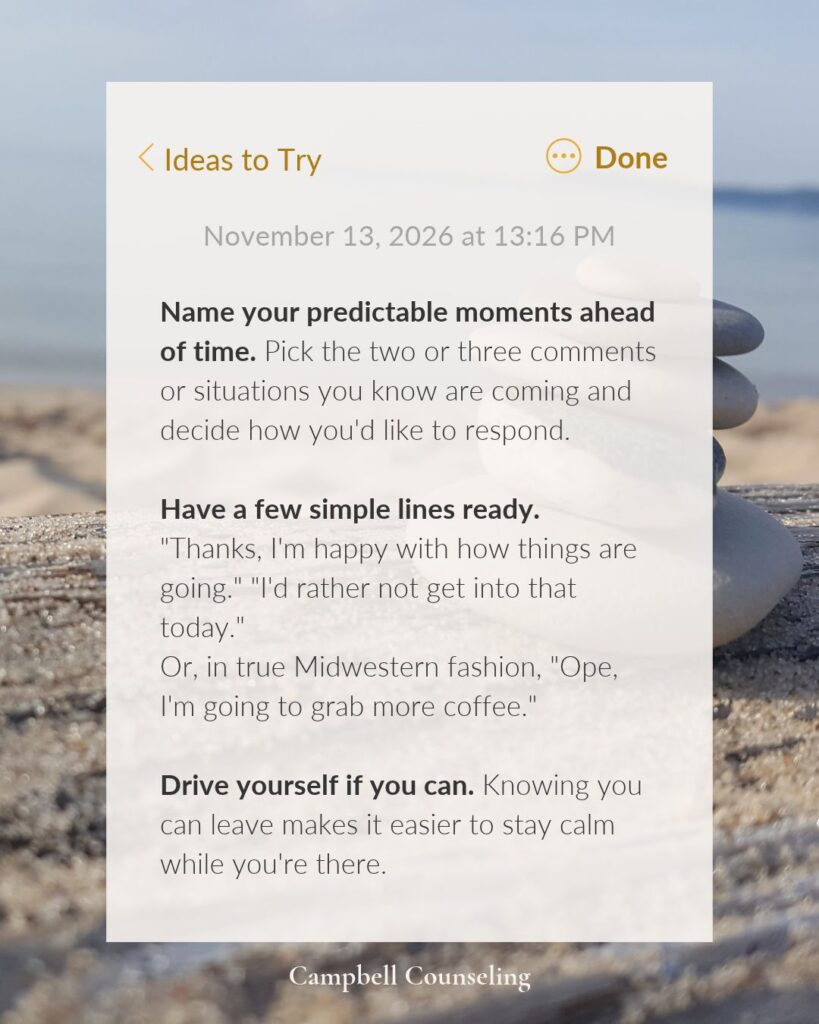
- Name your predictable moments ahead of time. Pick the two or three comments or situations you know are coming and decide how you’d like to respond.
- Have a few simple lines ready. “Thanks, I’m happy with how things are going.” “I’d rather not get into that today.” Or, in true Midwestern fashion, “Ope, I’m going to grab more coffee.”
- Drive yourself if you can. Knowing you can leave makes it easier to stay calm while you’re there.
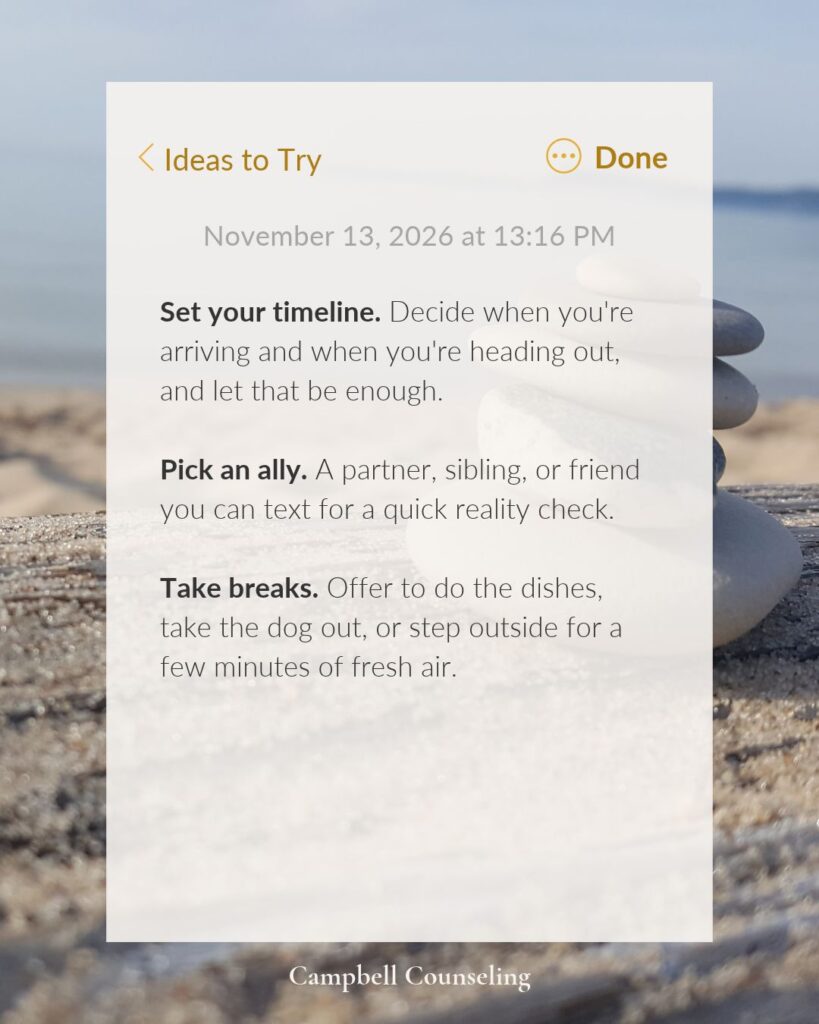
- Set your timeline. Decide when you’re arriving and when you’re heading out, and let that be enough.
- Pick an ally. A partner, sibling, or friend you can text for a quick reality check.
- Take breaks. Offer to do the dishes, take the dog out, or step outside for a few minutes of fresh air.
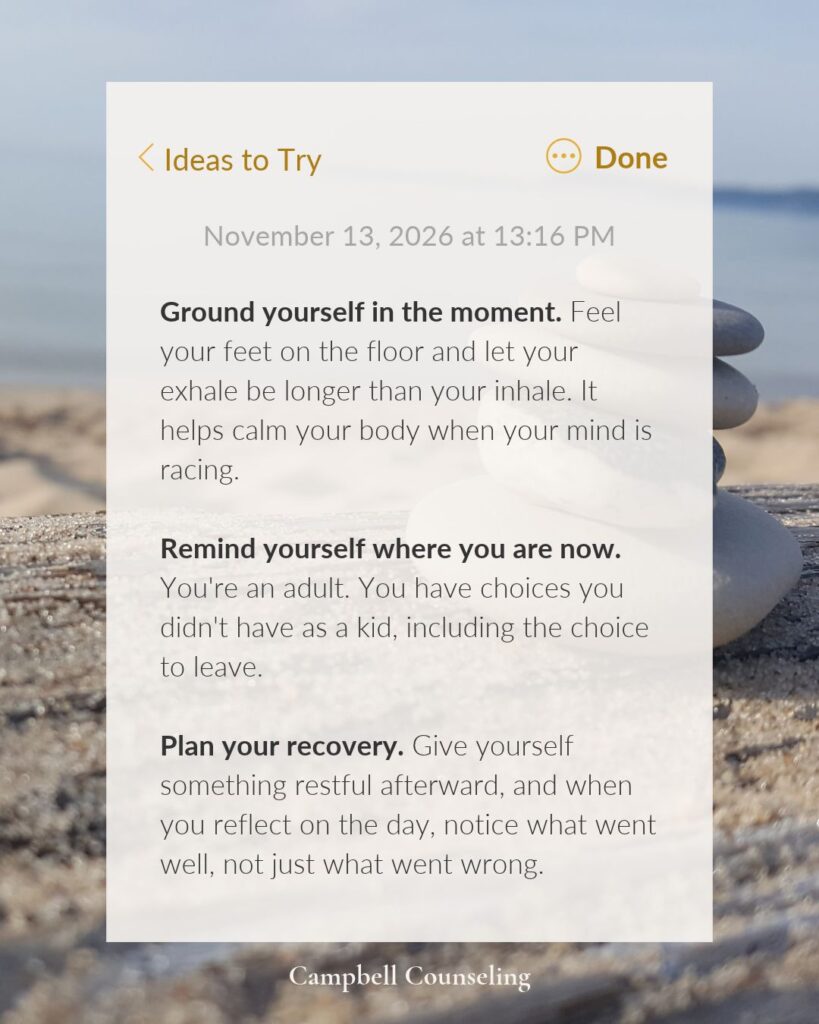
- Ground yourself in the moment. Feel your feet on the floor and let your exhale be longer than your inhale. It helps calm your body when your mind is racing.
- Remind yourself where you are now. You’re an adult. You have choices you didn’t have as a kid, including the choice to leave.
- Plan your recovery. Give yourself something restful afterward, and when you reflect on the day, notice what went well, not just what went wrong.
When It Feels Like More
If the holidays stir up more than you can sort through on your own, you don’t have to do it alone. Emma DeVault, LMHCA, sees adults for individual therapy around family patterns, people-pleasing, anxiety, and trauma. In mid-January, Emma will also lead Roots & Wings, a six-week virtual group for adults exploring how their family of origin shaped them. To learn more, reach out to Emma at Emma@CampbellCounselingIndy.com.
You’re not fifteen anymore. Even if it feels that way for a moment this season, you get to choose what happens next.