If you grew up in the Midwest, you probably learned the rules before anyone ever said them out loud. Say yes when you’re asked. Don’t make a fuss. If someone offers you the last piece of pie, say “oh, I couldn’t,” even if you absolutely could. Answer “how are you” with “fine” no matter what’s actually happening. Being easy, being agreeable, being no trouble at all, these aren’t just habits, they’re practically a regional love language.
The trouble is, none of that is the same thing as having a boundary.
We hear a version of this from clients often. Someone says yes to something they didn’t want to do, again, and can’t quite explain why. Someone feels resentful toward a family member but would never say so out loud. Someone apologizes for taking up space in a conversation they were invited into. None of this looks like conflict from the outside. It looks pleasant. It looks like someone being easy to get along with. But underneath it, there’s often exhaustion, a low hum of resentment, and a nagging sense of not quite knowing where they end and everyone else begins.
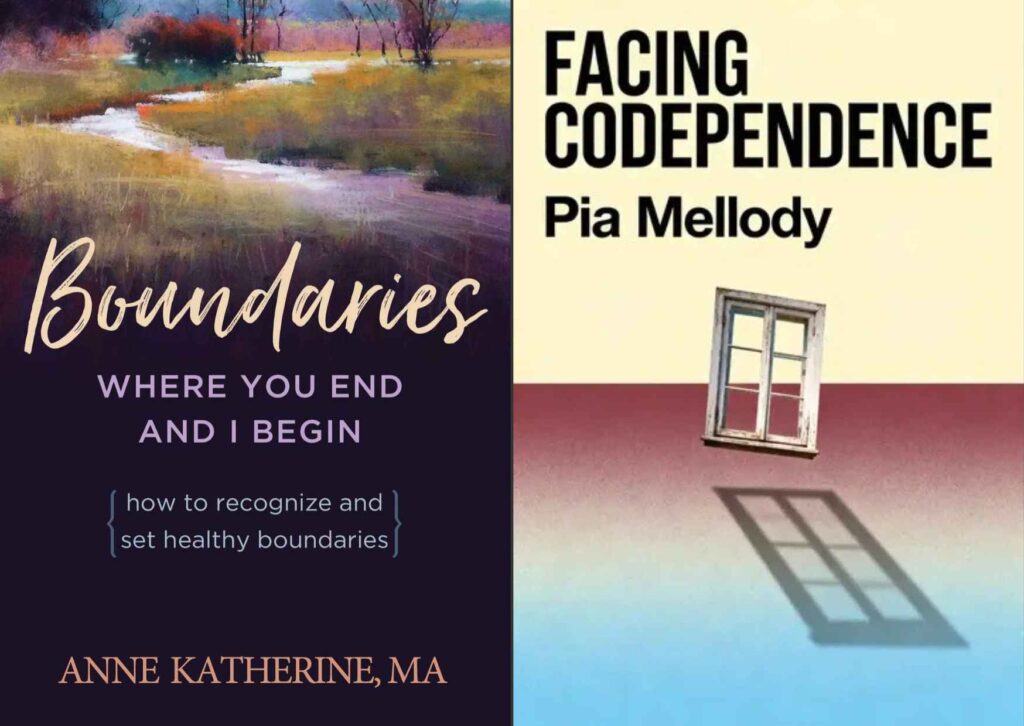
That last phrase comes from Anne Katherine’s book Boundaries: Where You End and I Begin, and it’s a useful way to think about what a boundary actually is. It isn’t a wall, and it isn’t a punishment for the other person. It’s simply the line that marks what’s yours to carry and what isn’t. Pia Mellody’s work on codependency describes something similar: many of us learned early on to manage other people’s feelings before we learned to notice our own. You likely learned to read a room before you learned to read. That skill can serve us well in some contexts. It becomes a problem when it’s the only mode we know how to operate in.
A few things we as clinicians see often when boundaries have blurred:
- Saying yes automatically, before checking in with whether you actually have the capacity or desire to say yes
- Feeling guilty for a “no,” even when the request wasn’t reasonable to begin with
- Explaining or justifying a boundary at length, as if it needs to be earned rather than simply stated
- Noticing resentment build in a relationship without ever naming what’s causing it
- Struggling to identify what you want, because you’ve spent so long tracking what everyone else wants instead
None of this means the politeness itself is the problem. Kindness and consideration are good things. The distinction is whether they’re a genuine choice or an automatic override, whether you’re being generous or just avoiding the discomfort of disappointing someone. A boundary isn’t the opposite of niceness. It’s what makes niceness sustainable instead of quietly costly.
A Boundary is About You, Not Them
One of the most common misunderstandings we see is the belief that a boundary is a request for someone else to change. It isn’t, and this distinction matters more than almost anything else in this conversation. A boundary isn’t “stop doing that.” A boundary is “here’s what I will or won’t continue to do if that keeps happening.” The first version depends on someone else’s cooperation. The second version is entirely within your own control, which is exactly why it works.
Put simply: an appropriate boundary describes your own action. An inappropriate boundary tries to control someone else’s.
A few examples with a partner or family member who tends to push back:
More likely to hold up:
- “If you raise your voice at me, I’m going to end the conversation and we can pick it back up later.” (Describes what you’ll do.)
- “I’m not able to lend money right now. I love you, and this isn’t a conversation I can keep having.” (States your own limit, once.)
- “I won’t be discussing my marriage at family dinners. If it comes up, I’ll change the subject or step away.” (Names your own response to the topic.)
More likely to backfire:
- “You need to stop calling me every day.” (Asks them to change, and puts you in the position of enforcing their behavior rather than your own.)
- “You have to be nicer to my partner or I won’t come to Thanksgiving.” (An ultimatum aimed at controlling someone else, not a boundary.)
- “Just don’t bring that up again.” (A request, not a boundary. There’s no stated response if it happens anyway.)
The second column isn’t wrong because the underlying want is unreasonable. Wanting to be spoken to respectfully, or wanting family gatherings without conflict, are entirely fair things to want. The issue is that phrasing it as a demand on someone else’s behavior hands them the control. Phrasing it as your own response hands it back to you. That’s also why a boundary doesn’t require the other person to agree with it, apologize for the behavior that prompted it, or even acknowledge that anything changed. It only requires you to follow through on what you said you’d do.
The Guilt Is Part of the Process, Not A Sign You’re Doing It Wrong
If you try setting a boundary and immediately feel like a terrible person, that’s not evidence you’ve overstepped. It’s usually evidence you’re doing something unfamiliar. Guilt and shame tend to show up right on schedule the first several times we hold a line, especially if we were raised to believe that a good person doesn’t cause anyone discomfort. That feeling is old wiring firing, not a signal to abandon the boundary. It tends to soften with repetition, even when it never fully disappears.
There’s also a quieter grief that can show up here, one we don’t talk about as often. Sometimes you set a boundary and the other person adjusts. And sometimes they don’t. They keep asking the same way, expecting the same access, following the same old rules, as if nothing changed. That can hurt in a specific way, a kind of mourning for the relationship you wished you had, or for how easy it used to feel before you started asking for something different. Both things can be true at once: the boundary was still worth setting, and it’s still painful when it isn’t met with the response you’d hoped for. You’re allowed to feel both.
A Few Small Ways to Practice
Boundaries are a skill, not a personality trait, which means they’re built through repetition rather than a single conversation.
A few places to start:
- Buy yourself a pause. “Let me check and get back to you” is a complete sentence.
- It interrupts the automatic yes and gives you a moment to actually check in with yourself before answering.
- Notice the body cue. Many people feel a boundary violation in their body (a tightness in the chest, a sinking stomach) before they can name it in words.
- Learning to notice that cue is often the first real step.
- Start with lower-stakes boundaries. Practice on the easier asks (a coworker, an acquaintance) before you take this into the relationship that feels hardest.
- Confidence tends to build sequentially, not all at once.
- State it once, without a paragraph of justification. “That doesn’t work for me” is a full answer.
- Over-explaining often comes from the same instinct that created the problem: the belief that your no needs to be earned.
- Expect the old pattern to test itself. People who benefited from your lack of boundaries, even unintentionally, will often push back at first.
- That pushback isn’t proof you were wrong. It’s often just proof the old pattern is trying to reassert itself.
- Let the relief be evidence. Even a small boundary, held once, often produces a felt sense of relief afterward.
- That relief is data. It’s worth paying attention to.
None of this means the politeness has to go, or that every relationship in your life needs an overhaul this week. It just means the niceness gets to become a choice again, instead of the only setting you know how to operate in. If it would help to have support figuring out where your own line is, and what to do with what comes up when you hold it, we’re here for that.