When most people picture ADHD, they picture a bouncing-off-the-walls little boy who can’t sit still in class. More recently, that picture has been joined by a new one: TikTok videos listing twenty-two “signs” of ADHD, framed as though nearly everyone might have it. Neither picture is wrong, exactly, but neither one tells you what ADHD actually looks like in adult women. And that gap is exactly why so many women spend years (sometimes decades) wondering what’s “wrong” with them before anyone gives them an accurate answer.
The Pop Culture Version Isn’t the Full Picture
Social media has done something valuable: it’s made ADHD part of the public conversation and helped a lot of women recognize themselves for the first time. But it’s also flattened a complex neurodevelopmental condition into a relatable checklist, and that cuts both ways. Some traits get pathologized when they’re just normal human variation. Other, more serious patterns get minimized because they’ve been repackaged as quirky or aesthetic.

The clinical reality is more specific than a viral list.
ADHD in women tends to look less like the hyperactive, impulsive presentation most people associate with the diagnosis, and more like the inattentive presentation: trouble sustaining focus, difficulty organizing tasks, losing track of time, mental fatigue from trying to keep it all together. It’s quieter. It’s easier to miss. And it’s often mistaken for a personality trait rather than a brain-based difference in executive functioning.
Why So Many Women Weren’t Diagnosed as Girls
Historically, boys have been diagnosed with ADHD at far higher rates than girls in childhood. Some research puts the ratio as high as 2:1 to 17:1 depending on the study and setting. That gap narrows significantly by adulthood, which tells us it was never really about who has ADHD. It was about who got noticed.
Girls with ADHD are more often the daydreamer than the disruptor. They’re the ones labeled “spacey,” “chatty,” or “a little disorganized,” rather than referred for an evaluation. Many compensate by working twice as hard to appear put-together, which means their struggle stays invisible right up until the demands of adult life (a career, a household, a marriage, kids of their own) outpace whatever coping strategies got them through school.
Research also shows that roughly 60% of women diagnosed with ADHD in childhood continue to meet criteria as adults, compared to about 30% of men, and that symptoms can shift with hormonal changes across the lifespan: postpartum, the menstrual cycle, and especially perimenopause and menopause, when the large majority of women in recent studies report their ADHD symptoms getting noticeably worse. None of that is factored into a diagnostic model that was built almost entirely around how ADHD shows up in boys.
What girls got instead of a diagnosis were labels: spacey, chatty, careless, unmotivated. Unlike a diagnosis, those labels don’t come with an explanation. They just come with a story about who you are, and that story doesn’t stay in childhood. It grows into something heavier: shame.

Where the Shame Comes From
Almost every adult woman we talk to who has ADHD can trace that shame back to specific people and specific moments: a parent who said she was lazy, a teacher who called her out for daydreaming in front of the class, friends who joked about how “scattered” she was, a report card that said she “wasn’t living up to her potential.” None of the adults saying those things knew they were describing a treatable, brain-based difference.
What they left behind was a narrative: I’m lazy, I’m too much, I’m not trying hard enough, something is wrong with me. That narrative got absorbed and repeated internally for years, often long before anyone had the language of ADHD to explain what was actually happening.
That narrative doesn’t disappear the moment someone receives an accurate diagnosis. A diagnosis can bring relief and clarity, but the shame that built up over years of being misunderstood needs its own attention. In my view, addressing that shame directly, not just managing symptoms, has to be part of real ADHD treatment. Learning executive functioning strategies matters. So does unlearning the belief that you were ever broken, lazy, or not enough. Part of unlearning it is making sure the diagnosis underneath it is actually correct, because ADHD isn’t the only thing that can produce those same struggles.
Why an Accurate Diagnosis Matters
Inattention, restlessness, forgetfulness, and feeling perpetually overwhelmed aren’t unique to ADHD. Anxiety can produce a racing, distractible mind. Unresolved trauma can produce hypervigilance that looks a lot like an inability to focus. Chronic stress can mimic executive dysfunction. A woman can walk into an evaluation with a lifetime of these symptoms and have the actual root cause be ADHD, anxiety, trauma, or some combination of all three; each of those calls for a different treatment approach. Get it wrong, and you can spend years managing the wrong problem, and carrying shame for struggling with a treatment plan that was never going to fit in the first place.
That’s why the process of getting diagnosed deserves as much attention as the diagnosis itself. It’s become common for adults to bring ADHD concerns to a primary care visit and leave fifteen minutes later with a stimulant prescription. A primary care provider can be a great partner in ongoing care, but a short appointment built around a symptom checklist isn’t equipped to rule out the other conditions that can produce the same symptoms: anxiety, trauma, depression, sleep disorders, thyroid issues, and more.
A comprehensive evaluation looks different. It typically includes a full clinical interview, a developmental and family history, standardized cognitive and attention testing, and a deliberate process of ruling out other explanations before ADHD is confirmed as the diagnosis. That thoroughness isn’t red tape; it’s protective. Stimulant medication can be genuinely helpful for an ADHD brain and genuinely risky, including habit-forming, for a brain that doesn’t actually have ADHD. Getting a real assessment before starting medication protects both the accuracy of your treatment and your long-term health.
Once You Understand Your ADHD, You Can Build What Actually Works

Once the diagnosis is accurate (and separated from the anxiety, trauma, or old shame story that may have been tangled up with it), the real work becomes learning what your ADHD specifically looks like, so you can build something around it that actually works for you.
ADHD looks different from one woman to the next, which means the systems that help are personal, too. Understanding your own attention patterns, energy cycles, and specific executive function challenges, rather than trying to force yourself into a generic productivity system or white-knuckle your way through willpower, is what allows you to build structures that actually hold up: the calendar system that works for your brain, the environment that reduces friction instead of adding to it, the routines that account for how your focus really moves through a day.
This is the part that gets skipped when ADHD is treated as something to medicate and move past. Sustainable functioning comes from systems and self-understanding working together, not from trying harder at something your brain was never going to do the neurotypical way.
If This Is Resonating
If any of this sounds familiar (the years of feeling like you were somehow failing at things that seemed to come easily to everyone else, the diagnosis that never quite fit, the exhaustion of holding it all together), it may be worth exploring what’s actually going on with a proper evaluation.
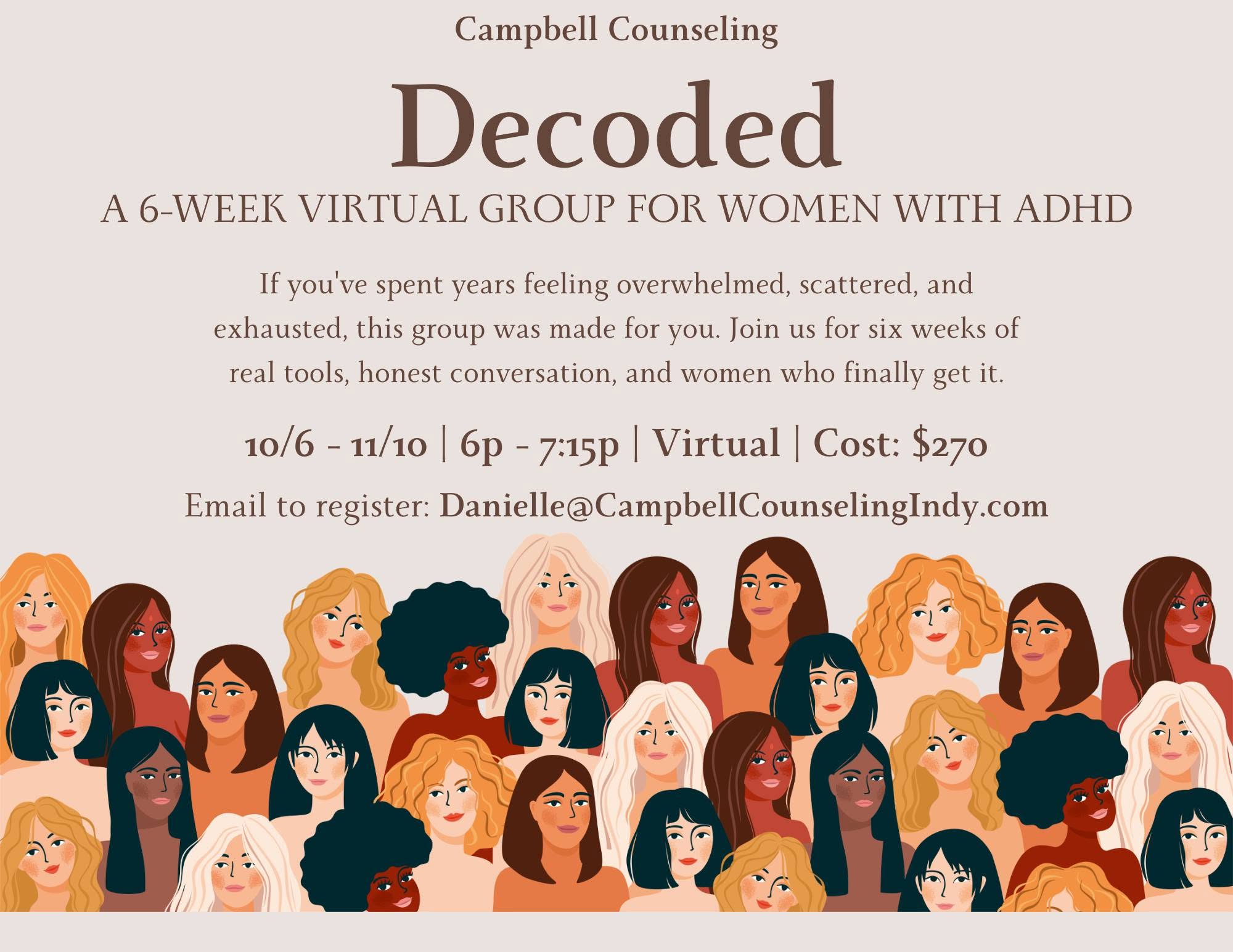
For women who are ready to go a step further and connect with others who understand it from the inside, we’re offering Decoded, a 6-week virtual group for women with ADHD, running October 6 to November 10, 6:00 to 7:15pm. It’s built around real tools, honest conversation, and the kind of understanding that only comes from being in a room with women who get it. Cost is $270.
To register, email Danielle@CampbellCounselingIndy.com.

We’re here when you’re ready.
Campbell Counseling is a group therapy practice on the Northside of Indianapolis. We offer individual therapy, couples therapy, therapy for kids and teens, and specialty groups and workshops. In-network with UHC/Optum and Anthem.