There is a particular kind of grief that does not have a clean name.
It’s not the grief of losing someone. It’s the grief of watching someone disappear while they’re still standing in front of you. Still in the same chair. Still with the same hands, the same face, the same voice, and yet somehow not quite the person you’ve always known.
If you are caring for a loved one with dementia, you know exactly what this feels like. And if you’ve been trying to explain it to people who haven’t lived it, you also know how hard it is to find the words.

The Loss That Happens Before the Loss
Dementia takes people in pieces. That’s what makes it so disorienting, and so uniquely painful.
With other losses, there is a moment. A before and an after. Dementia doesn’t work that way. It works slowly, unevenly, in ways that can feel like a long series of small heartbreaks rather than one clear one. Your mother might still recognize your face but not your name. Your father might still laugh at the same things but lose the thread of what he was laughing about. Your spouse might be physically present, sitting across from you at dinner, and feel completely unreachable.
You are grieving someone who is still alive. And because they’re still alive, the grief doesn’t always feel permitted. There’s no funeral. No casseroles at the door. No official acknowledgment that something has been lost.
As someone who is walking this road with my own mother right now, I can tell you: it is one of the stranger kinds of pain. The person is there. And also not there. And you love them, and you miss them, and sometimes both of those things are happening in the same moment.
When the Relationship Was Already Complicated
Not every caregiver is caring for someone they had an easy relationship with.
For many adults, caring for a parent with dementia means showing up, fully, consistently, often exhaustingly, for someone who didn’t always show up for them. A parent who was emotionally unavailable, critical, distant, or difficult. A parent who had their own unmet needs that spilled into the relationship in ways that left marks. A parent you loved but also had complicated feelings about for most of your life.
And now you’re their caregiver.
That layer of complexity is real, and it rarely gets named. Because how do you grieve the loss of someone you had a hard relationship with? How do you show up with patience and compassion for someone who didn’t model those things for you? How do you care for a parent who perhaps wasn’t a good caregiver to you, without the resentment, the old wounds, the grief for the relationship you never quite had, surfacing right alongside the grief of watching them fade?
There’s no clean answer. But it’s worth saying clearly: if you are in this situation, your experience is not less valid because the relationship was complicated. It may actually be harder. You may be grieving multiple things at once, the parent you’re losing now, and the parent you always wished you’d had. That is an enormous amount to carry.
The Guilt That Comes With It
Here’s something that most caregivers carry quietly: the guilt.
Guilt for getting annoyed when your loved one asks the same question for the fifth time in an hour. Guilt for feeling resentful of the role, of the loss of your own time and freedom, of what this has cost you. Guilt for sometimes wishing it would just be over, not because you want them gone, but because you’re exhausted and you can’t see the end.
And for those with complicated histories, guilt for the anger that surfaces. For the moments when the old dynamics show up even through the dementia. For not feeling the kind of uncomplicated devotion that caregiving is supposed to look like from the outside.
These feelings are not evidence that you’re a bad person. They’re evidence that you’re a human being in an extraordinarily hard situation. Resentment and love can exist in the same person at the same time. Exhaustion doesn’t cancel out devotion. Needing a break doesn’t mean you’ve stopped caring.
The guilt, though, tends to keep caregivers from talking about any of this honestly, which means they carry it alone, which makes everything harder.
What Caregivers Are Actually Carrying
The weight of dementia caregiving is hard to overstate. It’s not just the physical demands, the appointments, the medications, the safety monitoring, the logistics that never stop. It’s the emotional labor of managing your own grief while showing up for someone who may no longer fully know who you are. It’s the loneliness of doing something so all-consuming that most people in your life can’t quite understand it, even when they’re trying to. It’s the slow disappearance of your own identity into the role, the way “caregiver” can gradually take up all the space where “you” used to be.
And it’s the ambiguity. There’s no roadmap. Every day can be different. The person you’re caring for may have good days that make the bad days more disorienting, not less. You might be told to cherish this time while also feeling like you’re running on empty. You might love your person deeply and also be struggling in ways that feel disloyal to name.
None of that is weakness. All of it is real.
No One Is Built to Carry This Alone
There’s a message in the caregiving world that goes something like this: take care of yourself so you can take care of them. And while that’s true, we want to say something more direct.
You are not built to carry this alone. Not because you’re not strong enough, you clearly are. But because this load is genuinely too heavy for one person. Because human beings need other people who understand what they’re going through. Because the isolation of caregiving is itself one of its most damaging aspects, and you deserve more than that.
Caring for yourself is part of caring for your loved one. But it’s also simply something you deserve, not as a strategy, but as a person. Your grief is real. Your exhaustion is real. Your need for support, for connection, for a space where you don’t have to explain yourself or justify what you’re feeling, is real.
The people who love you may want to help and not know how. The people in your life may not have the language for what you’re carrying. That doesn’t mean you have to go without support. It means you may need to find it somewhere that was built for exactly this.

If any of this resonates, you’re not alone, and there are people and spaces designed specifically for caregivers navigating this kind of loss.
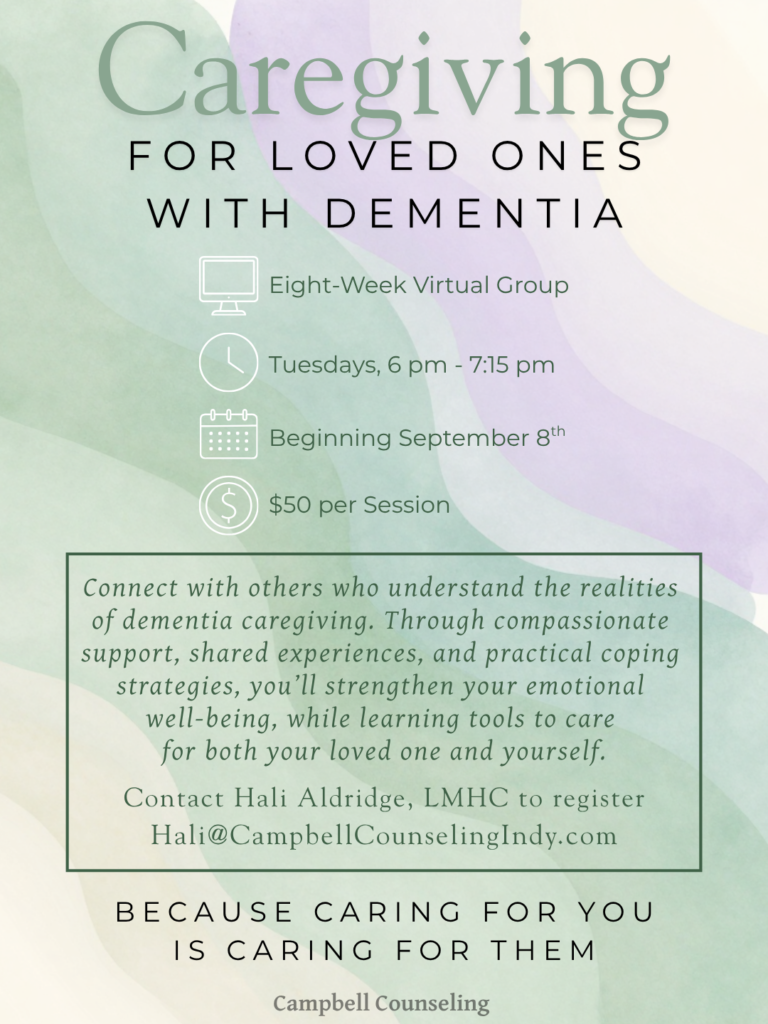
Hali Aldridge, one of our therapists at Campbell Counseling, is leading a support group this fall for people caring for loved ones with dementia.
Individual therapy is also available if you’d prefer to start there.
Campbell Counseling is a group private practice on the Northside of Indianapolis. We offer individual therapy, couples therapy, therapy for kids and teens, and specialty groups and workshops. In-network with UHC/Optum and Anthem.